.svg)
.svg)
.svg)
.svg)
.svg)
.svg)
.svg)
.svg)
.svg)
.svg)
.svg)
.svg)
On July 9, 2026, we wrote our first article about SpaceX. At that time, the stock had been trading on the market for a month and had already lost more than 30% of its value after peaking at $225. Our algorithm anticipated a brief recovery toward $172, followed by a steeper correction toward $100. That correction did occur, though sooner than expected. The interim recovery failed to materialize, and in early August, the stock price bottomed out around $105. This was followed by a strong rally to $176. Meanwhile, SpaceX released its first quarterly earnings report, and Starship reached Earth orbit for the first time.
Today, we’ll look at what has changed since July and what that means for the coming months. For some background, start by reading our article“SpaceX: First Weeks on the Stock Market, Stock price seeks stability.” You can find the article HERE.

What are the latest developments at SpaceX?
On August 4, SpaceX released its first quarterly earnings report as a publicly traded company. The results were better than expected.
Revenue rose 92% to $7.8 billion, while analysts had projected $6.8 billion. The net loss nearly halved, from $1.0 billion to $541 million. Starlink remained the driving force behind the growth. More than half of revenue came from the satellite internet service, and the number of customers grew from 10.3 million at the end of 2025 to 12 million. Starlink is also the only division that is profitable. The rocket launches and the AI division are still operating at a loss.
That profit engine received a major boost on September 28. Starship reached Earth orbit for the first time and deployed 26 next-generation Starlink satellites there. These satellites process ten times as much data as their predecessors. A fully loaded Starship can carry 60 of them—twenty times as many as a Falcon 9. According to Musk, customers won’t really notice a difference until there are about 1,000 new satellites. He expects to reach that point around the second quarter of 2027. That will require dozens of flights in a short period of time. Whether that pace is feasible remains to be seen in the coming months. Musk has previously fallen significantly behind his own schedule with Starship.
Offsetting this progress are two factors that could weigh on the stock price. The first is the AI division, which still costs far more than it generates. In the first half of the year, SpaceX invested approximately $28.5 billion, while its core business operations generated about $3.5 billion in cash flow. In the second quarter, 86% of all investments went toward AI infrastructure.
The second factor is the growing supply of shares. Employees and early investors were temporarily barred from selling after the IPO. That restriction—the lock-up—is expiring in stages. On October 9 and 24, approximately 328 million shares will be released on each date. Following the release of third-quarter results in early November, up to 1.3 billion shares could be added to the market. On December 8, the lock-up period ends for most shareholders. Until then, the additional supply could continue to weigh on the stock price.
What is the analysts’ outlook on SpaceX?
In July, analysts’ opinions varied unusually widely, ranging from $63 at Morningstar to $255 at Deutsche Bank. The tone is now clearly more positive. Based on 27 “Buy” recommendations, four “Hold” recommendations, and two “Sell” recommendations, the consensus is “Moderate Buy.” The average price target is $235. That is virtually the same as the $236 from our previous article. This is striking, given that the stock price fluctuated between $105 and $176 over the same three-month period.
Most major banks have recently raised their price targets, with targets ranging from $200 to $250. Analysts are particularly encouraged by the strong growth of Starlink and the progress made with Starship. However, concerns about high AI spending persist. As a result, opinions on SpaceX’s valuation still vary widely.
What is Yelza’s outlook on SpaceX’s stock price?
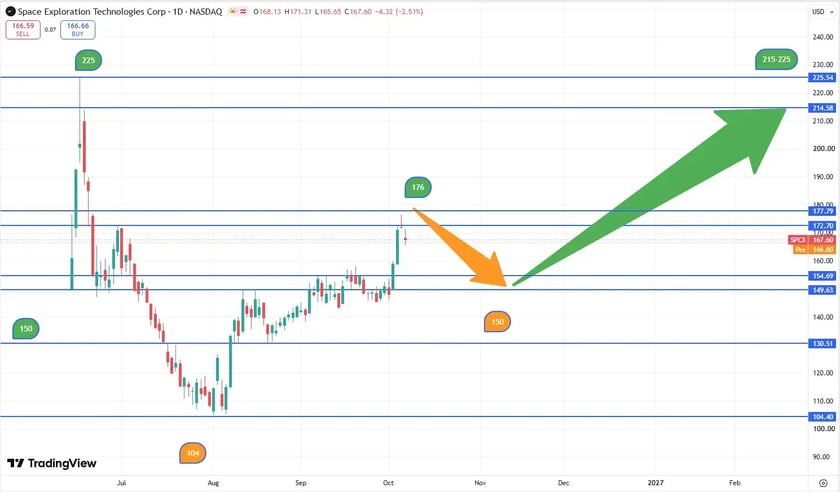
In July, our model predicted a correction toward $100. That correction came sooner than expected, without the anticipated interim recovery to $172. The bottom around $105 was just above our target. A strong recovery followed. In early October, the stock price briefly touched $176, just above the $172 level mentioned in our previous article.
Below is the price chart for SpaceX since its IPO. The arrows show the most likely scenario at a glance.
Source: TradingView, analysis by Yelza
In the short term, a new high cannot be ruled out. The price could still spike to around $180. According to our model, however, this would mark the end of the upward trend that began in August for the time being. The most likely scenario is then a pullback toward the $150 range. This correction will coincide with the release of shares in October and following the quarterly earnings report in November. The decline is not expected to follow a straight line.
From the $150 range, we expect the upward trend to resume. Lows have been rising steadily since August, and with a low around $150, that pattern remains intact. The price target lies in the range between $215 and $225, the area where the stock peaked shortly after its initial public offering. From $150, that represents an increase of approximately 45%. Our price target is thus slightly below the average analyst price target of $235.
Conclusion
In three months, SpaceX has shown that it’s more than just a story, with revenue nearly doubling, a rapidly growing Starlink, and a
Starship that has finally reached space—but these achievements are offset by sky-high AI expenses and a steady stream of new shares coming to market.
Our model therefore expects a temporary pullback toward the $150 range first, after which the path toward $215–$225 could open up. Those who already hold a position may consider holding it through to the price target and the volatile period surrounding the lock-ups and quarterly earnings, while those who entered around the August low may also consider locking in some profits and buying more in the $150 range.
Those who do not yet have a position would be wise not to chase the recent rally and may consider building a position during the pullback toward $150, with $215–$225 as the price target for 2027.
SpaceX’s third-quarter earnings are expected to be released on November 5.
Disclaimer: Investing involves risks. Our analysts are not financial advisors. Always consult an advisor when making financial decisions. The information and tips provided on this website are based on our analysts’ own insights and experiences. They are therefore intended for educational purposes only.
.webp)

.webp)
.webp)