.svg)
.svg)
.svg)
.svg)
.svg)
.svg)
.svg)
.svg)
.svg)
.svg)
.svg)
.svg)
For years, SpaceX was the best-known company that wasn’t publicly traded. Elon Musk kept the door to the public market closed for decades, arguing that the company needed to develop further first. That changed on June 12, 2026. SpaceX debuted on the Nasdaq under the ticker symbol SPCX, immediately marking the largest initial public offering in history.
It’s time to take a closer look at SpaceX. We’ll examine the company behind the scenes, look back at the IPO and the first few weeks of trading, and conclude with our outlook for the period ahead.
How did the IPO go?
The road to the stock market was not without controversy. Prior to the listing, Senator Elizabeth Warren sent a letter to the U.S. Securities and Exchange Commission (SEC) expressing concerns about SpaceX’s corporate governance structure and questioning whether investors were receiving sufficient information to assess the record valuation.
That criticism did little to affect demand for the stock. In the run-up to the offering, Reuters reported that the IPO was already nearly four times oversubscribed, with an order book reportedly totaling $250 billion compared to a planned offering size that ultimately came in at $75 billion.
A notable feature of the structure was the allocation to retail investors. Whereas in a typical IPO only a few percent of the shares go to retail investors, SpaceX reserved approximately 30% of the offering for individual investors. The shares were offered through well-known brokerage platforms, allowing a broad public to participate directly for the first time.
SpaceX ultimately priced the shares at $135, valuing the company at $1.77 trillion at the time of its debut. This immediately made it the seventh-largest company in the world, well ahead of names like Saudi Aramco and Tesla. The first day of trading was exuberant. The stock opened around $150 and climbed nearly 20% within a few hours to approximately $161.75. That temporarily pushed the market capitalization above $2 trillion. More than 500 million shares were traded on that first day, a volume comparable to Facebook’s initial public offering in 2012. The euphoria continued for a while: on June 16, the stock reached its all-time high of $225.64, more than 65% above the initial public offering price.
What kind of company is SpaceX?
When people think of SpaceX, rockets quickly come to mind. And rightly so, because that’s how the company got its start in 2002. The Space segment includes the reusable Falcon 9 and Falcon Heavy, which SpaceX uses to launch satellites, supply missions, and astronauts into Earth orbit, including for NASA. In addition, the company is working on Starship, an even larger and fully reusable system for future missions to the Moon and Mars. That reusability is precisely what analysts attribute to SpaceX’s edge over its competitors: no other company currently launches at comparable costs and frequency.
Yet SpaceX has since expanded beyond just rockets. In addition to Space, the company also comprises Connectivity and AI:
- Connectivity: This segment revolves around Starlink, the satellite internet service provided via approximately 9,600 satellites. In 2025, it grew by 50% to $11.4 billion in revenue, accounting for over 60% of total revenue. The number of active customers rose to more than 10.3 million in 160 countries, more than double the figure at the end of 2024.
- AI: This is the newest segment and was established in February 2026, when SpaceX acquired Musk’s AI company xAI. This brought the Grok language model, the X platform, and the Colossus data center platform into the company. Colossus provides computing capacity to companies such as Anthropic and Google, making SpaceX a player in the AI infrastructure market as well.
That growth comes at a price. Capital expenditures on AI infrastructure rose to $10.1 billion in the first quarter of 2026, compared to $4.1 billion a year earlier. As a result, SpaceX posted a net loss of nearly $5 billion for all of 2025, despite strong revenue growth. For a company of this size, that’s not an alarming figure, but it does show that the AI division is currently costing more than it’s generating.
What is the analysts’ outlook on SpaceX?
For most major stocks, there is a reasonable degree of consensus among analysts. Remarkably, that is not the case with SpaceX. Immediately after the IPO, CFRA issued a sell recommendation and a price target of $115, partly due to the company’s high capital intensity and the as-yet-unproven returns on its AI investments. Morningstar also arrives at a significantly lower valuation, at $63 per share.
On the other hand, Deutsche Bank has a buy recommendation and a price target of $255, and Morgan Stanley estimates approximately 100% upside potential. Citi even cites a long-term target of over $900. The average price target across all analysts currently stands at around $236.
This spread is mainly due to the fact that investors now have to value SpaceX as three companies at once: a rocket manufacturer, a telecom provider, and an AI infrastructure player. Depending on which future scenario you envision, you’ll arrive at a very different price target.
What is Yelza’s outlook on SpaceX’s stock price?
Below you’ll find SpaceX’s stock chart since its IPO, including our expectations for the near future. The arrows show the most likely scenario at a glance.
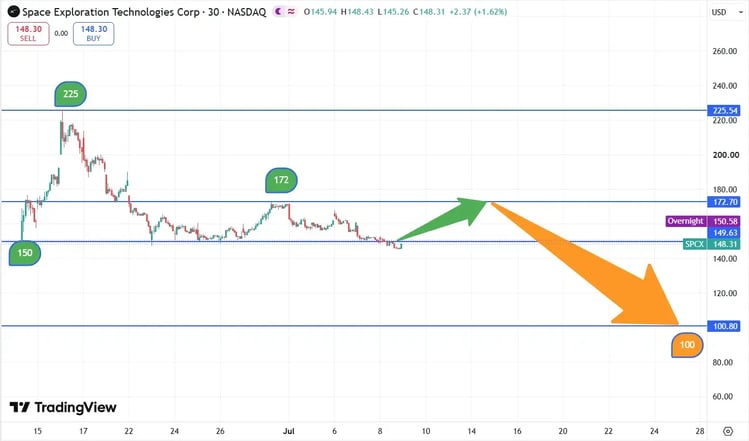
After peaking at $225.64 on June 16, a sharp correction followed. On June 23, the stock hit a low of approximately $147, a drop of more than 30% from the peak, though the price still remained above the initial public offering price of $135. Since then, the stock has been fluctuating erratically between roughly $145 and $172, meaning that its price typically moves much more sharply than the broader market.
Our model shows that the current zone around $150 is acting as a key support level. The most likely scenario is that the price will initiate an initial upward move from here toward $172, the level it previously tested in late June. However, we do not expect an immediate breakout at that level. Instead, our system anticipates a reversal: from the $172 zone, a new, more pronounced correction could begin, pushing the price back toward $100. That would represent a decline of more than 40% from that interim high.
Conclusion
With this IPO, SpaceX has instantly become one of the bigger names on the Nasdaq, but the stock does not yet have a long track record, and analysts’ opinions are unusually divided. This makes it primarily a company to watch, not necessarily a stock on which a definitive judgment can be made just yet.
This article is therefore primarily intended to inform you about the company, the background of the IPO, and the first few weeks of trading. For now, our model suggests an interim recovery, followed by a larger correction toward $100. Anyone following the stock would be wise to keep an eye on both levels before considering an investment.
An important milestone is coming up on August 6, 2026. On that date, SpaceX will publish its first quarterly results as a publicly traded company, and at the same time, the first lock-up period will expire, allowing some insiders to sell shares for the first time. Both events could cause additional volatility. We are closely monitoring developments and will publish a follow-up article as soon as more clarity emerges.
Disclaimer: Investing involves risks. Our analysts are not financial advisors. Always consult an advisor when making financial decisions. The information and tips provided on this website are based on our analysts’ own insights and experiences. They are therefore intended for educational purposes only.
.webp)

.webp)
.webp)