.svg)
.svg)
.svg)
.svg)
.svg)
.svg)
.svg)
.svg)
.svg)
.svg)
.svg)
.svg)
Nvidia released its financial results for the second quarter of fiscal year 2027 on Wednesday evening after the U.S. stock market closed. In this article, we discuss what Nvidia specifically presented this week and what this means for the stock price. We’ll also look ahead: what does Nvidia itself expect for the coming months, and what does that mean for the broader AI sector? Finally, we’ll share our technical outlook on the stock price, including a revised price target.
We recommend that you first read our April 30, 2026, article ,“Nvidia Remains the Driving Force Behind the AI Revolution: Price Target Raised to $285,” so that you are fully up to speed on the background. You can find the article HERE.
What were the key figures for the second quarter?
Nvidia reported revenue of $96.2 billion, a 106% increase year-over-year and an 18% increase compared to the previous quarter. Analysts had, on average, expected revenue of approximately $92 billion, making this a clear positive surprise.
The majority of that revenue about $89 billion came from sales of chips and systems for data centers: the large computing centers where companies train and run their AI models. This segment grew by 117% year-over-year and now accounts for 92% of total revenue. As a result, Nvidia has essentially become a company that relies almost entirely on the global expansion of AI infrastructure.
Nvidia also performed strongly in terms of profitability. The gross margin came in at 75%, meaning that for every dollar of revenue, 75 cents remains before costs such as personnel, research, and marketing are deducted. That is an exceptionally high percentage for a company that manufactures physical products (chips), and it underscores the strong pricing power Nvidia currently holds. Earnings per share came in at $2.22 (adjusted for one-time items), an increase from the expected $2.09. Earnings were also positively impacted by a $7.8 billion paper gain on its investments in other companies, including Intel and SpaceX.
Nvidia returned approximately $26 billion to shareholders during the quarter through share buybacks and dividends. It still has $99 billion in headroom to continue this policy in the coming period. With this result, Nvidia exceeded analysts’ expectations for the fifteenth consecutive quarter.
Outlook: What does Nvidia expect for the coming period?
For the current third quarter, Nvidia itself is forecasting revenue of $108 billion, plus or minus 2%. That is well above what analysts had expected (approximately $104 billion) and would mean that, for the first time in history, Nvidia would exceed the $100 billion revenue mark in a single quarter.
Perhaps even more important than this single quarter is the longer-term outlook. During the conference call, CFO Colette Kress provided an unusually early forecast for fiscal year 2028: Nvidia expects revenue growth of approximately 70% for that year, well above the roughly 44% that analysts had previously projected. Kress emphasized that customer demand is now higher than what Nvidia can supply, and that the 70% figure reflects the company’s own production capacity rather than a ceiling on demand. This statement sparked a striking turnaround in the stock market: while the stock was still down about 3% in after-hours trading immediately following the release of the figures, the price rebounded to a gain of approximately 4 to 5% following this clarification.
The outlook remains strong in other areas as well. Nvidia indicated that demand for its latest generation of chips, called Vera Rubin, will begin to pick up this fiscal year. The company also highlighted the broader investment plans of its largest customers: the five largest tech companies building data centers intend to increase their combined investments next year from approximately $800 billion to $1.3 trillion. As long as that wave of investment continues, it will remain a strong tailwind for Nvidia.
A concrete example of that sustained demand: this week it was announced that Amazon will purchase two million Nvidia chips for its own cloud data centers, partly based on the new Vera Rubin technology. This underscores that the world’s largest tech companies continue to invest heavily in Nvidia’s technology, despite all the discussion about a possible “AI bubble.”
What is the analysts’ outlook on Nvidia’s stock price?
Analysts remain overwhelmingly positive. Of the analysts covering the stock, 58 have a “buy” rating, compared to 1 “sell” rating. The average price target ranges from $305 to $311, with a high estimate of $500 and a conservative estimate of $180. Wedbush analyst Matt Bryson, who specializes in semiconductor stocks, had already set a price target of $330 ahead of the earnings release. The main arguments behind this positive outlook remain largely unchanged. Analysts point to the dominant position Nvidia has established in data center chips, the expected contribution of the upcoming Rubin platform to future growth, and the persistently high willingness to invest among major tech companies that are building and expanding data centers worldwide.
What is Yelza’s outlook on Nvidia’s stock price?
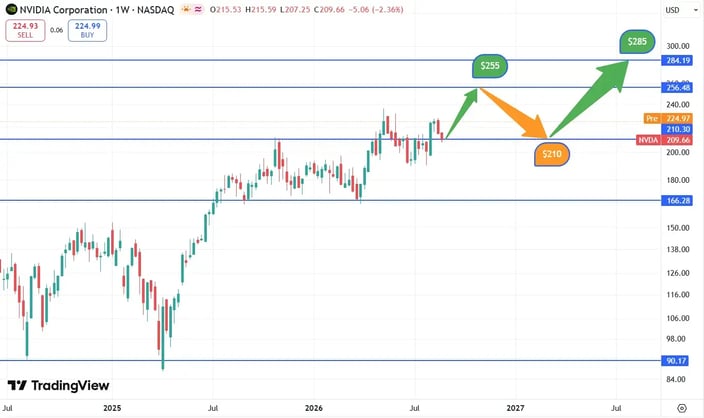
Below you’ll find Nvidia’s stock price chart for the recent period. The arrows show, at a glance, the most likely scenario according to our model.
Source: TradingView, analysis by Yelza
Since our article on April 30, the stock price has largely moved as expected. Nvidia continued its upward trend and is currently trading around $210.
In the short term, our algorithm anticipates an initial upward move toward the $255 range. This level represents a key resistance where the price is expected to temporarily stall. From there, we anticipate a corrective phase that will bring the price back toward the support zone around $210 the same level where the stock has already been finding support for some time. Such a correction is consistent with a healthy uptrend and may present an interesting entry point for investors who do not yet hold a position.
After this corrective phase, we expect the uptrend to resume. Our long-term price target therefore remains unchanged at $285. The strong results and in particular the raised growth forecast for fiscal year 2028 confirm that the fundamental case behind this price target remains intact.
Conclusion
Nvidia continues to perform exceptionally well within a sector that is becoming increasingly important worldwide. This week’s results confirm that demand for AI computing power remains high, and the striking turnaround during the conference call shows that investors are primarily focused on the sustainability of this growth rate, not just on the results of a single quarter.
In the short term, we expect a volatile phase: first a test of the $255 range, followed by a correction toward $210. Should this correction occur, it could present an interesting opportunity to build or expand a position toward our price target of $285.
The combination of persistently strong demand, the upcoming contribution of the Vera Rubin chips, and the significantly raised growth forecast for 2028 supports this long-term narrative. For now, Nvidia thus remains one of the strongest stock stories within the global AI revolution.
Disclaimer: Investing involves risks. Our analysts are not financial advisors. Always consult an advisor when making financial decisions. The information and tips provided on this website are based on our analysts’ own insights and experiences. They are therefore intended for educational purposes only.
.webp)

.webp)
.webp)