.svg)
.svg)
.svg)
.svg)
.svg)
.svg)
.svg)
.svg)
.svg)
.svg)
.svg)
.svg)
Publication date: August 21, 2026
In this market calendar, we discuss the most important macro-economic developments and releases that could move the financial markets in the coming week.
A look back at the past week
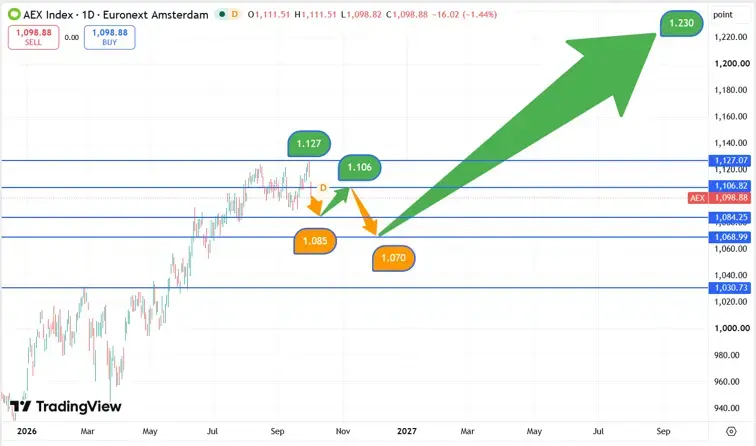
Stock markets edged lower last week. On Friday of the previous week, it was revealed that U.S. retail sales had unexpectedly declined in July. U.S. consumer confidence also fell significantly short of expectations. However, financial markets last week were primarily influenced by rising U.S. interest rates, increasing tensions in the Middle East, and doubts about the valuations of AI and chip companies. This led to significant profit-taking in stocks from these sectors.
The U.S. 30-year yield rose to 5.34% on Tuesday, its highest level since 2007. Long-term yields have also risen sharply in Germany, France, and Japan. Investors are demanding higher interest rates due to concerns about high government debt, rising budget deficits, and persistent inflation.
Higher interest rates are weighing particularly heavily on technology and growth stocks. This explains why technology stocks were hit significantly harder than stocks in defensive sectors.
A second major cause of the price declines is the geopolitical tensions surrounding Iran and the broader Middle East. Hopes for a
diplomatic solution have diminished over the past week, while tensions surrounding the Strait of Hormuz persist. As a result, the price of a barrel of Brent crude oil has risen again.
Outlook for the coming week:
The most important macroeconomic release for the coming week is the core PCE price index. This key indicator of U.S. inflation will be released on Wednesday at 2:30 p.m.
The core PCE price index is expected to have risen by 0.2% in July, compared with a 0.1% increase in the previous month. On a year-over-year basis, a 3.3% increase is expected. This means that core inflation remains well above the Federal Reserve’s 2% target.
At the same time, figures on U.S. economic growth in the second quarter will be released. Growth of 1.5% is expected. This would represent a significant slowdown compared to the 2.1% economic growth recorded in the first quarter.
In addition, investors continue to closely monitor developments in the Middle East. Increased tensions are driving up energy prices, which could further fuel inflation and thereby put upward pressure on interest rates. Conversely, an easing of geopolitical tensions could provide some relief to the financial markets.
Economic calendar for week 35
Below is an overview of the most important macroeconomic releases for the coming week. These figures may lead to increased volatility in the financial markets.
Monday, August 24, 2026:
Tuesday, August 25, 2026:
Europe:
-
8:00: German gross domestic product, second quarter
Wednesday, August 26, 2026:
United States:
-
14:30: Core PCE Price Index for July
-
14:30: Gross domestic product, second quarter
Thursday, August 27, 2026:
No major macro-economic releases.
Friday, August 28, 2026:
No major macro-economic releases.
Please note that publication dates and times are subject to change. For the most up-to-date information, always consult the official communication channels of the relevant institutions and government agencies.
Disclaimer: Investinginvolves risks. Our analysts are not financial advisors. Always consult an advisor when making financial decisions. The information and tips provided on this website are based on our analysts’ own insights and experiences. They are therefore intended solely for educational purposes.
.webp)

.webp)
.webp)