.svg)
.svg)
.svg)
.svg)
.svg)
.svg)
.svg)
.svg)
.svg)
.svg)
.svg)
.svg)
Publication Date: October 15, 2026
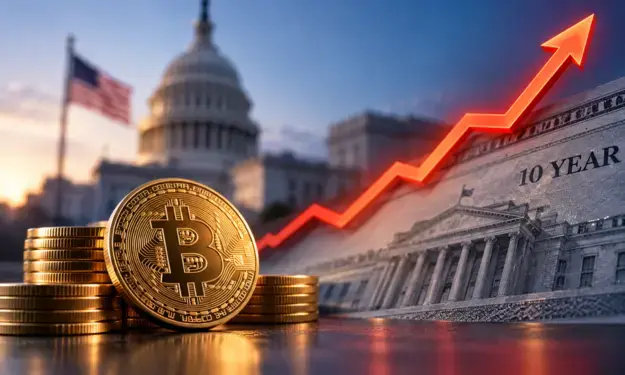
U.S. inflation rose more sharply than expected in September. This is causing new uncertainty in the financial markets and is also putting pressure on the crypto market. Bitcoin fell below $82,000 following the release of the inflation figures, while other cryptocurrencies also lost ground.
Attention is now shifting to the U.S. central bank, the Federal Reserve (Fed). The Fed will set interest rates again in late October. A further rate hike could have significant consequences for the crypto market. But why do U.S. interest rates have such a big impact on Bitcoin, and what can investors expect in the coming weeks?

U.S. Inflation Continues to Rise
On October 14, U.S. inflation figures for September were released. Inflation rose from 3.4% in August to 3.7% on a year-over-year basis, while economists had anticipated 3.6%. Higher energy prices, in particular, contributed to this increase.
Core inflation, which excludes food and energy, also came in higher than expected. It rose by 0.3% on a monthly basis, compared to an expected 0.2%. On a year-over-year basis, core inflation stood at 2.6%.
These figures are important because the Fed is trying to bring inflation back toward its 2% target. If prices continue to rise faster than desired, the central bank may decide to raise interest rates further to slow down the economy.
The crypto market reacted immediately to the release. Bitcoin fell toward $81,000, and Ethereum lost about 4% of its value.
In addition, approximately $455 million worth of trading positions were forced to close, mainly from investors who had bet on rising prices.
Why do higher interest rates affect crypto?
U.S. interest rates play a significant role in virtually all financial markets. When the Fed raises interest rates, it becomes more expensive for businesses and consumers to borrow money. At the same time, relatively safe investments, such as U.S. Treasury bonds, become more attractive because they yield higher interest rates. As a result, investors may decide to invest less money in riskier assets, including stocks and cryptocurrencies. Bitcoin and Ethereum, in particular, are sensitive to changes in the amount of money available for investment.
In addition, higher U.S. interest rates can strengthen the dollar. Since cryptocurrencies are primarily traded internationally in dollars, a stronger dollar can put additional pressure on crypto prices. This does not mean, however, that an interest rate hike automatically leads to falling crypto prices. Financial markets react primarily to developments that deviate from expectations. When investors have already priced in an interest rate hike, the actual decision may therefore have less of an impact.
What will the Federal Reserve do?
In September, the Fed raised interest rates for the first time since 2023, to a range of 3.75% to 4.00%. The next monetary policy meeting is scheduled for October 27 and 28. Ahead of that meeting, many investors still expect interest rates to remain unchanged. However, due to the disappointing inflation figures, the likelihood of another rate hike has increased. A potential rate hike in December also remains a distinct possibility.
For the crypto market, expectations for the coming months are particularly important. If the Fed signals that further rate hikes are necessary, this could once again create selling pressure . A less hawkish tone from the central bank, on the other hand, could provide relief. If investors expect interest rates to remain stable for the time being, interest in riskier investments may pick up again.
What can we expect from Bitcoin?
The coming weeks will be crucial for Bitcoin’s future price trajectory. Following the recent decline, attention is focused primarily on the $80,000 to $81,000 range, where the price previously found support.
If the Fed decides to leave interest rates unchanged while simultaneously placing less emphasis on future hikes, Bitcoin could potentially rebound toward $84,000 to $84,500. A convincing breakout above this zone would improve the short-term technical outlook.
If, on the other hand, the Fed continues to emphasize the need for further rate hikes, selling pressure could persist. A drop below the recent low around $80,200 would increase the risk of a further correction.
Still, there are also positive developments. U.S. Bitcoin ETFs recorded another inflow of approximately $176 million on October 13, following a period in which investors had actually been withdrawing funds. In addition, companies such as Strive continue to expand their Bitcoin holdings. These developments show that institutional interest in Bitcoin has not completely disappeared, despite the uncertainty surrounding U.S. interest rates.
Conclusion
Higher-than-expected U.S. inflation is once again causing uncertainty within the crypto market. The likelihood of further interest rate hikes by the Fed has increased, which remains a key factor, especially for high-risk investments such as Bitcoin and Ethereum.
At the same time, recent inflows into Bitcoin ETFs and continued purchases by large companies show that interest from institutional investors still exists.
The October 28 interest rate meeting will therefore be a crucial moment for the crypto market. The Fed’s statement, in particular, will determine expectations heading into December. For Bitcoin, the question remains whether the price will find enough support to move toward higher levels again, or whether persistent inflationary pressure will trigger a further correction.
Disclaimer: Investing involves risks. Our analysts are not financial advisors. Always consult an advisor when making financial decisions. The information and tips on this website are based on our analysts’ own insights and experiences. They are therefore intended for educational purposes only.