.svg)
.svg)
.svg)
.svg)
.svg)
.svg)
.svg)
.svg)
.svg)
.svg)
.svg)
.svg)
In February of this year, we discussed SAP in response to a notable price reaction. At the time, the stock had fallen sharply despite strong full-year results for 2025, and we noted then that this correction seemed more like an opportunity than a problem. It has now been well over half a year, and SAP has published results for two quarters. It’s time to take stock and reassess our outlook for the coming period.
We recommend that you first read our previous article from February 4, 2026, titled “SAP: Strong results, stock price reaction offers new entry opportunity,” so that you are fully up to speed on the background.

What developments have taken place at SAP since February 2026?
On April 23, SAP published its first-quarter 2026 earnings report. These results were generally well-received and confirmed that the company had returned to an upward trajectory following the January stock price decline.
The second-quarter results followed on July 23, and that quarter was also impressive. Total revenue rose by 9 percent to nearly 9.9 billion euros, with cloud revenue increasing by 22 percent to 6.3 billion euros. In particular, the so-called cloud backlog, the value of cloud contracts already signed but not yet billed, stood out with a 27 percent increase to 22.9 billion euros. This figure gives investors a good indication of future revenue visibility and thus showed a clear acceleration compared to the two previous quarters.
Operating profit came in at just over 2.6 billion euros, an 8 percent increase. At the same time, SAP slightly adjusted its profit forecast for the full year 2026 downward, from 11.9 to 12.3 billion to 11.8 to 12.2 billion euros. This is not a sign of disappointing operational performance, but rather the result of the acquisitions of Dremio and Prior Labs. Both companies strengthen SAP’s offerings in the areas of data and artificial intelligence, but are temporarily putting pressure on margins during the ramp-up phase.
SAP is also strongly committed to its so-called Autonomous Enterprise strategy. During the annual Sapphire conference in May, the company introduced a new Business AI Platform and dozens of autonomous AI agents that help customers automate business processes. The figures show that this strategy is paying off: artificial intelligence and the SAP Business Data Cloud platform were part of more than 90 percent of the fifty largest deals in the second quarter. Shareholders were not forgotten either. SAP increased its dividend by more than 10 percent and continued its ongoing €10 billion share buyback program.
What is the analysts’ outlook on SAP’s stock price?
Analysts remain overwhelmingly positive about SAP. Most research firms have a “buy” or “strong buy” recommendation, and based on the most recent estimates, the average 12-month price target ranges from 190 to 220 euros, with some projections exceeding 290 euros. Analysts point to the continued growth of the cloud backlog and the widespread adoption of SAP Business AI as the key drivers for the coming quarters.
It is notable, however, that the gap between the current share price and the average price target has narrowed significantly in recent months. Following the sharp decline earlier this year and the subsequent recovery, the short-term upside potential has become more limited than it was at that time. Analysts emphasize that the second half of the year will be decisive: SAP itself expects a slight slowdown in cloud growth in 2026, which could result in a less clear-cut picture in the coming quarters than in the recent period.
What is Yelza’s outlook on SAP’s stock price?
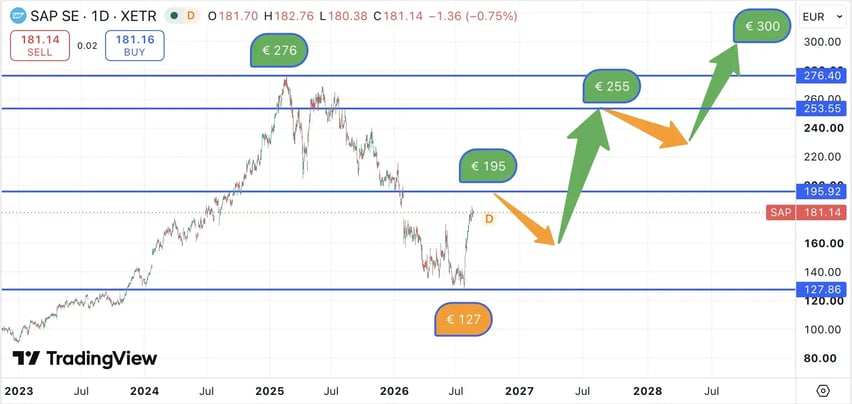
Below you’ll find SAP’s stock price chart starting in 2023. The arrows show the most likely scenario at a glance.
Source: TradingView, analysis by Yelza
In our previous article, we suggested building a position around the then-current level of €160. From that level, however, the stock continued to decline, hitting a low of approximately €127 in the spring. Since then, SAP has fully recovered from the downtrend, and the stock is once again trading around €180. This price movement underscores once again just how severe and volatile the correction phase was, but at the same time demonstrates how quickly the recovery can take hold once sentiment shifts.
Our algorithm anticipates an initial test of the resistance zone around €195 in the coming period, well below the previous record high of €276 from early 2025. Around this level, we expect an initial pullback, during which the price will give back a portion of its recent gains. This would not signal a break in the recovery, but rather a healthy pause within a larger uptrend. From that correction zone, our system then forecasts a strong follow-through move toward €255. At that level as well, we anticipate another, smaller pullback before the uptrend resumes toward the long-term price target of €300.
The structural growth of the cloud business, the upcoming wave of migration to S/4HANA Cloud as support for the older Business Suite 7 systems ends, and the increasingly widespread adoption of SAP Business AI form the underlying foundation for this. The scenario therefore does not follow a straight line upward but rather a series of successive steps with interim corrections, which is consistent with the erratic price movements SAP has already exhibited in recent years.
Conclusion
SAP has demonstrated in recent months that the price decline at the beginning of this year had more to do with market sentiment than with the underlying financials. Two consecutive strong quarters confirm that the cloud strategy and the rise of SAP Business AI are firmly anchored in the business model. The stock price has now once again surpassed the previously recommended entry zone around €160 after a full downward swing and subsequent rebound.
If you built a position around €160 at that time, you may want to consider holding onto it as the price moves toward the first resistance zone around €195. Keep in mind that a pullback from that level is possible; this fits within the scenario we outlined and, in and of itself, need not be a cause for concern. If you don’t yet have a position, such a corrective phase could actually be a good time to consider entering the market, with the next targets set at €255 and ultimately €300 in sight for the coming years.
SAP will release its third-quarter 2026 earnings on Wednesday, October 21, after the market closes.
Disclaimer: Investing involves risks. Our analysts are not financial advisors. Always consult an advisor when making financial decisions. The information and tips provided on this website are based on our analysts’ own insights and experiences. They are therefore intended for educational purposes only.
.webp)

.webp)
.webp)