.svg)
.svg)
.svg)
.svg)
.svg)
.svg)
.svg)
.svg)
.svg)
.svg)
.svg)
.svg)
What is a market correction?
← Back to FAQ
A market correction is a temporary decline in the stock market after a period of rising prices. It is usually referred to as a correction when an index or share falls by approximately 10% to 20% from a recent peak. It is smaller than a bear market and is considered a normal movement within the market.

A correction often brings prices back to a more realistic level.
After a strong rise, shares can become relatively expensive because investors are very optimistic. When expectations are adjusted or profits are taken, prices may decline. This process is called a correction.
It is a natural market reaction in which excessive increases are partly reversed. Corrections occur regularly and are part of healthy market movements. They do not automatically mean that there is an economic crisis.
Short example:
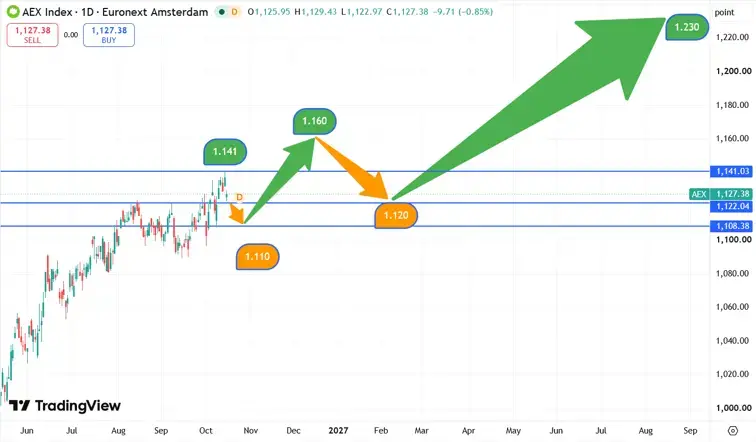
Suppose an index rises from 1,000 points to 1,200 points. After this strong increase, the index falls to 1,080 points. That is a decline of 120 points. 120 divided by 1,200 equals 10%. The market has then fallen 10% from the peak, which is considered a correction.
Disclaimer: Investing brings risks. Our analysts are not financial advisors. Always consult an advisor when making financial decisions. The information and tips provided on this website are based on our analysts' own insights and experiences. Therefore, they are for educational purposes only.