.svg)
.svg)
.svg)
.svg)
.svg)
.svg)
.svg)
.svg)
.svg)
.svg)
.svg)
.svg)
On July 3, 2025, we published our previous article on gold entitled "Gold: A Shiny Future." At that time, the gold price was quoted at $3,350. Just seven months later, gold was quoted about 65% higher at $5,600. The upside potential outlined earlier thus revealed itself faster and more powerfully than expected.
The question that now arises is how investors should position themselves for the period ahead. In this article, we analyze the short-term and recalibrate the long-term price target.
For background information, please refer to our earlier article. Click HERE for the article "Gold: A Shiny Future".

Why did gold prices rise so much in 2025?
Gold's sharp rise was the result of a combination of macroeconomic, monetary and geopolitical factors.
First, expectations increased that central banks, including the U.S. Federal Reserve, would cut interest rates. This made gold relatively more attractive relative to bonds. At the same time, a weakening U.S. dollar created additional upward pressure, as gold is priced in dollars.
In addition, geopolitical uncertainty again played an important role. Tensions on the world stage, combined with structural purchases by central banks, strengthened the demand for gold. Several countries increased their gold reserves to be less dependent on traditional reserve currencies.
Technically, gold also broke through several key resistance levels. This attracted additional capital from momentum investors and further accelerated the rise.
What do banks and analysts expect?
Many international banks and analysts are structurally positive about gold. They assume that central banks worldwide will continue to accumulate gold and that investors will continue to view gold as a safe haven in times of uncertainty.
UBS, J.P. Morgan and Deutsche Bank, among others, count on a gold price well above $6,000 by 2026.
At the same time, some analysts point to the risk of temporary consolidation and increased volatility, for example, if interest rate hikes return or the U.S. dollar regains strength. Nevertheless, the general consensus remains overwhelmingly positive. Most forecasts assume that gold will quote above its current level of around $5,000 by 2026.
Yelza's view
Below we show the price chart of gold since July 2025, including the most likely scenario according to our model.
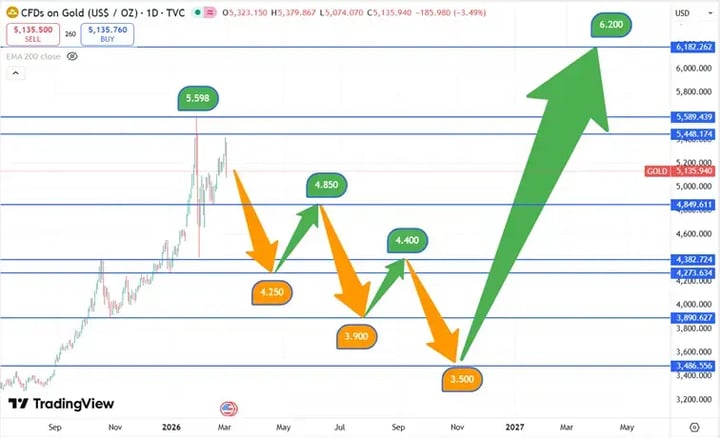
Our algorithm expects a volatile and on balance downward price trend for the next six months. In doing so, the technical correction could even lead to a drop towards $3,500. This would represent a decline of about 40% from the recent peak, but remains within the broader long-term upward pattern.
After this correction phase, we expect the structural uptrend to resume. Our system's long-term price target is set at $6,200 by 2027.
Conclusion
For the short-term, our model foresees a volatile and downward phase. Short-term investors may consider unwinding part of their position to reduce risk.
During the correction towards $3,900 and even possibly to $3,500, several powerful recovery moves are expected to occur. Active investors can capitalize on this tactically.
For the longer term, the picture remains constructive. After a healthy correction, we consider it likely that gold will continue its advance and reach new record levels above $6,000 in the coming years.
As soon as the expected correction ends, we will publish a new update. At that time, taking a position again may be considered. We will keep you informed.
Disclaimer: Investing involves risk. Our analysts are not financial advisors. Always consult an advisor when making financial decisions. The information and tips provided on this website are based on our analysts' own insights and experiences. They are therefore for educational purposes only.
.webp)

.webp)
.webp)