.svg)
.svg)
.svg)
.svg)
.svg)
.svg)
.svg)
.svg)
.svg)
.svg)
.svg)
.svg)
What is compound interest
← Back to FAQ
Compound interest means that you earn interest on your original amount as well as on the interest previously accumulated. As a result, your return does not grow linearly, but exponentially and therefore increasingly faster over time. This effect is also referred to as interest on interest.
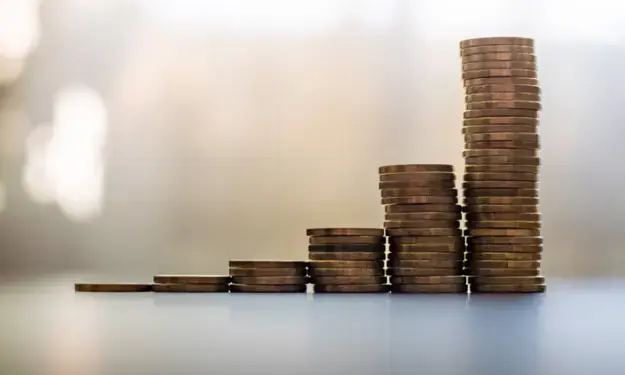
The longer your money is allowed to grow, the stronger the effect of compound interest becomes.
With compound interest, the return is continuously added to the total amount, after which new returns are calculated on the higher balance. This creates a snowball effect. In the beginning, growth may seem limited, but over time the increase becomes visibly stronger.
Compound interest plays an important role in long term investing and saving, as time is a decisive factor. The earlier you start and the longer you invest, the greater the potential difference in the final outcome.
Short example:
Suppose you invest €1,000 at an annual return of 5%. After the first year, you have €1,050. In the second year, you receive 5% on €1,050, which equals €52.50. Your total then becomes €1,102.50. In the third year, you receive 5% on €1,102.50, which equals €55.13. You now have €1,157.63. You can see that the amount grows slightly faster each year, because you also earn returns on previously earned interest.
Disclaimer: Investing brings risks. Our analysts are not financial advisors. Always consult an advisor when making financial decisions. The information and tips provided on this website are based on our analysts' own insights and experiences. Therefore, they are for educational purposes only.