.svg)
.svg)
.svg)
.svg)
.svg)
.svg)
.svg)
.svg)
.svg)
.svg)
.svg)
.svg)
What is a moving average?
← Back to FAQ
A moving average is a technical indicator that calculates the average price of an asset over a specific period of time. It smooths out short term price fluctuations to help identify the overall trend. Traders use moving averages to better understand the direction of the market.
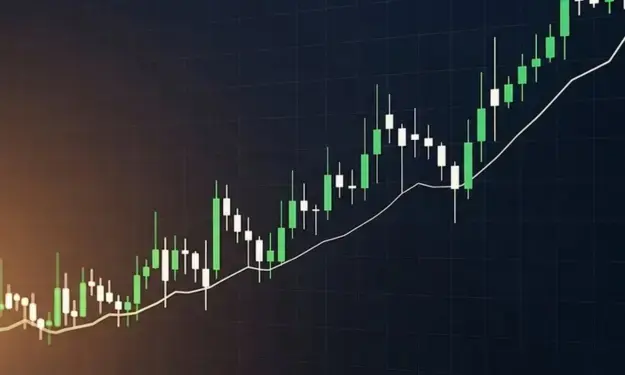
A moving average reduces noise and highlights the underlying trend.
The indicator is calculated by taking the average closing price over a set number of periods, such as 20, 50, or 200 days. As new price data becomes available, the oldest data point is removed and the average is recalculated, which is why it is called “moving.” Shorter period moving averages react more quickly to price changes, while longer period averages provide a smoother and more stable trend signal.
Moving averages are often used to identify support and resistance levels or to generate trading signals when one average crosses another. However, because they are based on past prices, they lag behind current market movements.
Short example:
Suppose a stock’s closing prices over the last five days are 100, 102, 104, 106, and 108.
The five day moving average would be the average of those prices, which equals 104.
On the next day, if the closing price is 110, the oldest value of 100 is removed from the calculation and replaced by 110. The new five day moving average becomes 106. If the stock price consistently remains above the moving average, traders may interpret this as an upward trend, while a move below the average could signal potential weakness.
Disclaimer: Investing brings risks. Our analysts are not financial advisors. Always consult an advisor when making financial decisions. The information and tips provided on this website are based on our analysts' own insights and experiences. Therefore, they are for educational purposes only.