.svg)
.svg)
.svg)
.svg)
.svg)
.svg)
.svg)
.svg)
.svg)
.svg)
.svg)
.svg)
← Back to Crypto FAQ
Zero-knowledge proof is a cryptographic method that allows someone to prove they know something without revealing the information itself. In the crypto world, it is used to verify transactions without exposing sensitive data. This makes it a powerful tool for privacy and security on the blockchain.
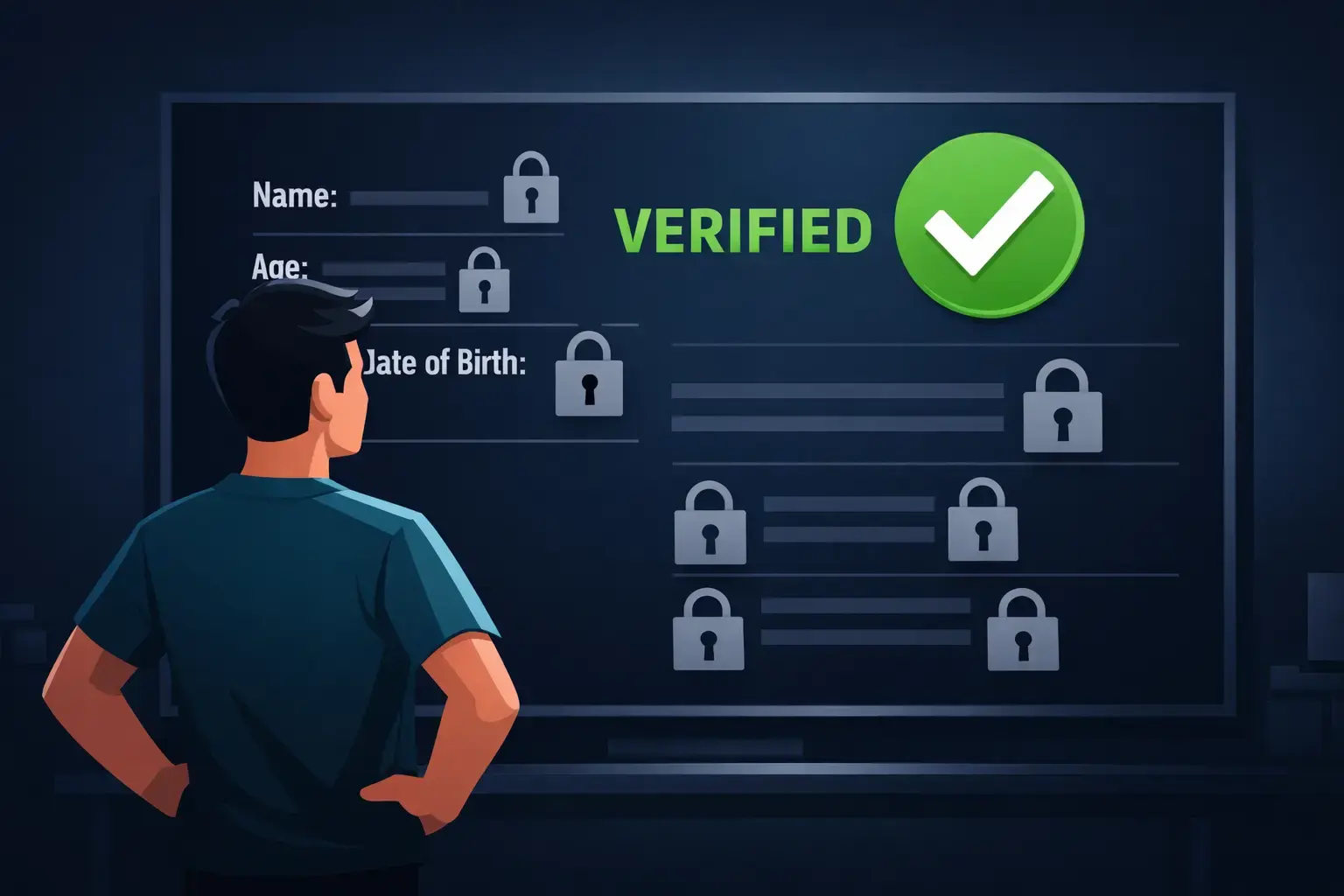
With a zero-knowledge proof, there are two parties: the prover and the verifier. The prover wants to demonstrate that they possess certain information, while the verifier wants to confirm this. What makes it remarkable is that by the end of the process, the verifier knows with certainty that the prover has the information, but has learned nothing about the information itself.
To qualify as a true zero-knowledge proof, a method must meet three properties: completeness, soundness, and zero-knowledge. Completeness means that if the prover genuinely possesses the information, an honest verifier will always accept this. Soundness ensures that if the prover does not possess the information, they cannot convince the verifier and the chance of fraud is virtually zero. Finally, the zero-knowledge property guarantees that the verifier learns nothing beyond the fact that the prover holds the information. No additional knowledge is transferred.
Zero-knowledge proofs are used in several ways within blockchain and crypto. Privacy coins like Zcash use them to make transactions fully private, proving that a transaction is valid without revealing the amount, sender, or recipient on the blockchain. Another major application is zk-Rollups, a technology that makes blockchains like Ethereum faster and cheaper by processing thousands of transactions outside the main blockchain and bundling them into a single proof. This dramatically reduces network congestion without sacrificing security. Beyond payments, zero-knowledge proofs also play a role in identity verification, making it possible to confirm your identity or certain attributes without sharing personal data. Think of age verification, KYC processes, or access to financial services. Finally, by combining zero-knowledge proofs with smart contracts, complex transactions can be executed privately and automatically, without third parties having any insight into the details.
Short example:
Suppose you want to prove that you are old enough to use a platform, without sharing your date of birth. With a zero-knowledge proof, you can demonstrate that you are over 18 years old, without the other party ever seeing your exact age or personal details. The verifier only knows that you meet the requirement and nothing more.
Disclaimer: Investing brings risks. Our analysts are not financial advisors. Always consult an advisor when making financial decisions. The information and tips provided on this website are based on our analysts' own insights and experiences. Therefore, they are for educational purposes only.

-2.webp)