
.svg)
.svg)
.svg)
.svg)
.svg)
.svg)
.svg)
.svg)
.svg)
.svg)
.svg)
.svg)
Publication date: December 4, 2025
Stablecoins and tokenized assets are playing an increasing role in the modern crypto market. While many crypto currencies are known for strong fluctuations, stablecoins and tokenized assets actually focus on stability, security and connecting traditional financial markets with blockchain technology. This category is growing rapidly and is the basis for many applications within DeFi, payments and global transactions. In this article, we explain exactly what stablecoins and stable assets are, how tokenization works and why these developments are so important in today's market.
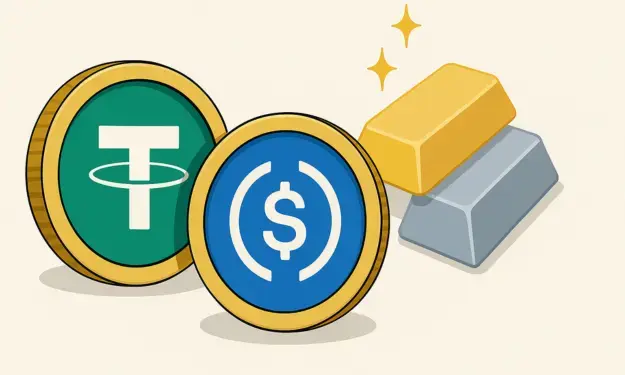
What are stablecoins and why do they exist
Stablecoins are cryptocurrencies tied to a stable value, typically the U.S. dollar. As a result, the price hardly fluctuates at all. Whereas Bitcoin and other altcoins are known for their volatility, stablecoins actually offer security. This makes them suitable as a means of payment, a parking spot for capital and a fundamental building block in DeFi.
The best-known stablecoins are USDT, USDC and DAI. These three dominate the market and are used daily for transactions on exchanges, sending money between countries and setting up financial products in the digital economy.
Stablecoins exist because traditional crypto is too volatile for everyday use. For example, an entrepreneur who wants to send international payments cannot rely on a currency that can drop in value by 10 percent overnight. Investors also use stablecoins as a way to trade quickly without constantly returning to traditional banks. The growth of stablecoins follows the same trend as digital payments worldwide. It offers speed, low fees and instant transactions.
How do stablecoins work
Stablecoins fall into three categories. The first category is fiat-backed stablecoins such as USDT and USDC. These are fully backed by dollars in a bank account or other low-risk financial products such as government bonds. The second category is backed stablecoins such as DAI. These are backed by other cryptocurrencies tied up in smart contracts. The third category is algorithmic stablecoins that try to achieve stability with smart software. This category is riskier and has seen several failed projects in the past.
In practice, stablecoins work simply. For every coin issued, there is a reserve that supports the value. When someone converts the stablecoin back to dollars, the coin is destroyed and the reserve is released. This makes stablecoins flexible and transparent. This makes it much more than just a digital currency. It forms the backbone of the modern crypto market.
What are stable assets?
Stable assets are digital forms of traditional financial products such as gold, bonds, or currency. Unlike stablecoins that are almost always tied to the dollar, a stable asset represents the value of a specific real asset. Consider gold digitally represented on a blockchain or a token that tracks the value of a government bond. Stable assets are becoming increasingly popular with investors who want to use digital products without being exposed to the extreme volatility of crypto.
A key advantage of stable assets is that they are tradable globally without banks or intermediaries. This allows investors to access assets that would normally be difficult to access. In addition, blockchain offers transparency, making ownership, transactions and reserves faster and clearer than in traditional markets.
What are tokenized assets and how does tokenization work
Tokenized assets are physical or financial assets captured in digital form on a blockchain. This process is called tokenization. In this process, for example, a real estate asset, a bond or a bundle of commodities is converted into a token. That token represents part or all of the underlying asset. This makes it possible to break down large assets into small digital pieces. This creates greater liquidity and accessibility.
The demand for tokenization is growing rapidly as large financial institutions such as BlackRock, JPMorgan and Franklin Templeton are increasingly investing in digital markets. More and more bonds, real estate portfolios and funds are becoming available as tokens. This makes for lower entry costs and faster trading because blockchain automates the entire process.
Tokenization works in three steps. First, the physical or financial asset is assessed and legally recorded. Then it is converted into a digital token that represents property rights. Finally, the token becomes tradable on a blockchain. This structure makes it possible, for example, to buy a piece of a building without having to finance the entire building.
Why stablecoins and tokenized assets are becoming increasingly important
Stablecoins and tokenized assets form a bridge between traditional finance and blockchain technology. They make digital economies more stable, accessible and scalable. In countries where national currencies are falling sharply in value, stablecoins are increasingly being used as a digital alternative. In international trade, stablecoins provide faster and cheaper transactions.
Tokenized assets are mainly changing the world of investment. Institutional parties see the benefits of blockchain for efficiency, transparency and liquidity. As a result, the tokenization market is likely to become one of the biggest growth areas within crypto in the coming years. Stablecoins, meanwhile, remain the engine of the daily blockchain economy. Without stablecoins, DeFi, NFT marketplaces and new payment networks would not function as they do today.
Conclusion
Stablecoins, stable assets and tokenized assets are the foundation of the modern crypto world. Stablecoins offer stability and speed in a market known for volatility. Stable assets make digital versions of existing financial products available to all. Tokenized assets make large and often illiquid assets much more accessible. The combination of these developments makes blockchain increasingly relevant to investors, corporations and financial institutions. These sectors are expected to continue to grow in the coming years and become an important part of the global digital economy.
Disclaimer: Investing involves risk. Our analysts are not financial advisors. Always consult an advisor when making financial decisions. The information and tips provided on this website are based on our analysts' own insights and experiences. They are therefore for educational purposes only.


-2.webp)