
.svg)
.svg)
.svg)
.svg)
.svg)
.svg)
.svg)
.svg)
.svg)
.svg)
.svg)
.svg)
Publication date: December 11, 2025
Blockchain is a term you hear everywhere these days, but for many novice investors it remains a vague and sometimes even intimidating concept. Yet the core is surprisingly simple: the blockchain is nothing more than a digital system that securely stores information without the need for a central party, such as a bank. Below, we explain step by step how it works so you understand exactly what you're dealing with as a crypto investor.
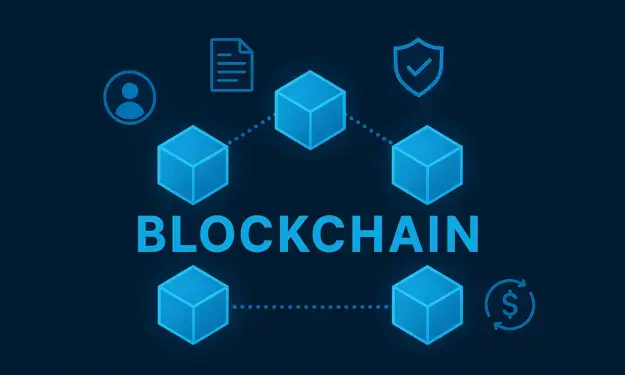
What is the blockchain
You can best think of the blockchain as a digital cash book kept by thousands of computers at once. That cash book records what transactions have taken place: who sends something, who receives something, and exactly how much it is. Unlike a bank, where one organization controls the cash book, the blockchain belongs to no one and everyone. The network controls itself, making fraud or altering data virtually impossible.
What is a "block"
Transactions that occur on a blockchain are not stored one at a time. They are collected in a package: a block. Think of it as a page from the cash book. Each page is full of transactions, and once it is full, it is closed.
That closing is done in a very special way. Each page (block) is given a unique code, a kind of digital fingerprint. This code links the block to the block before it. This creates a chain of blocks: the blockchain.
Why is it so secure?
The security of the blockchain comes from two main components:
1. Linkage between the blocks: Because each block is connected to the previous block, you can't change anything without the whole chain changing. A small change would be noticed immediately.
2. Thousands of computers check the same information: The blockchain is not stored in one place, but on a whole network of computers. If one computer tries to change something, it immediately stands out because the rest have a different, correct copy. The majority always wins. This keeps the system fair and transparent.
How are blocks added?
To add new blocks, the network must agree on what the correct transactions are. This is done in two ways:
Proof-of-Work (like Bitcoin).
Computers solve complicated puzzles. The computer that does it first gets to add the new block to the chain. This takes a lot of energy, but provides strong security.
Proof-of-Stake (like Ethereum since 2022)
Instead of puzzles, validators are chosen based on the amount of cryptocurrency they capture. This is more energy efficient and faster.
What happens in a transaction?
When you send crypto, your transaction goes through three steps:
-
Send: You indicate through your wallet that you want to send crypto to another address.
-
Checking: The network verifies that you actually own the crypto and that the transaction is valid.
-
Record: The transaction is recorded in a new block. Once that block is added, your transaction is fixed. No one can reverse it.
Why is blockchain so important
For many users, blockchain offers one big advantage: you no longer have to rely on one organization. The network solves that trust through math, transparency and decentralization. This allows payments to be made quickly, cheaply and globally without an intermediary.
In addition, blockchain forms the basis for a variety of new applications such as smart contracts, DeFi, NFTs and tokenization. These technologies could permanently change the world of finance, logistics, gaming and even the way property is recorded.
Conclusion
Blockchain may sound technical, but at its core it is a simple concept: a digital ledger managed not by one party, but by thousands at a time. Thanks to this structure, the blockchain is secure, reliable and almost impossible to manipulate. These very characteristics make it one of the most influential technological developments of our time.
Disclaimer: Investing involves risk. Our analysts are not financial advisors. Always consult an advisor when making financial decisions. The information and tips provided on this website are based on our analysts' own insights and experiences. They are therefore for educational purposes only.


-2.webp)