.svg)
.svg)
.svg)
.svg)
.svg)
.svg)
.svg)
.svg)
.svg)
.svg)
.svg)
.svg)
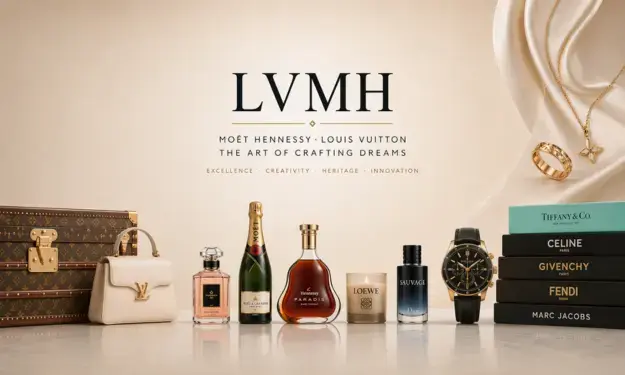
LVMH, in full Moët Hennessy Louis Vuitton, is the world's largest luxury group. Listed on Euronext Paris, the French company owns more than 75 brands across five segments: from Louis Vuitton and Dior in fashion and leather goods, to Bulgari in watches and jewelry, Moët & Chandon and Hennessy in wines and spirits and Sephora in retailing. Top executive Bernard Arnault spent decades building this portfolio through acquisitions and tight brand management. The result is a company that structurally benefits from growing global demand for luxury, with a customer base that is little affected by economic cycles.
Yet the share price has been under pressure for some time. The market is wavering. We analyze the situation and give our vision of what is to come.
What is the current situation at LVMH?
On April 13, LVMH released its figures for the first quarter of 2026. Reported revenue came in at €19.1 billion, compared with €20.3 billion in the same period a year earlier. At first glance that seems disappointing, but the broader context makes a significant difference.
The strong euro cost LVMH as much as 7 percentage points of reported growth in this quarter. That has nothing to do with the performance of the company itself, but purely with exchange rates. If you filter that out and look at organic growth, that is, what the company did on its own, you see a 1% plus. Modest, but positive. In addition, the ongoing conflict in the Middle East depressed organic growth by another 1 percentage point, as Arab tourists have less presence in European luxury stores.
Add those two external effects together, and LVMH would have come close to meeting analyst expectations of 1.5% organic growth without headwinds. That colors the picture substantially differently.
Results by division vary widely, and that is precisely the strength of the LVMH model: if one segment disappoints, the others make up for it. The standout of the quarter is Watches and Jewelry with 7% organic growth. Bulgari performed excellently, particularly in Asia. Wines and Spirits grew 5%, helped by recovering U.S. premium consumption. Selective Retailing, which includes Sephora, posted 4% organic growth.
Then the concern: Fashion and Leather Goods shrank 2%. This is LVMH's largest and most profitable division. Louis Vuitton and Dior saw demand in Europe decline, while the expected return of Chinese tourists fell short of expectations. Europe as a whole shrank organically by 3%. That weakness is offset by strength in Asia: excluding Japan, the region grew organically by 7%. Chinese luxury consumers are cautiously moving back into the market, although the question remains whether this recovery is sustainable.
What are analysts' views on LVMH's share price?
Looking at the analyst consensus shows a remarkably unified picture. For a stock that has already corrected sharply, there is virtually no sell recommendation outstanding. The majority of the analysts who actively follow LVMH recommend buying, and that is by no means a given for stocks of this size.
The reasoning behind that buy recommendation is consistent: the current price decline is disproportionate to what the company is fundamentally worth. LVMH has something that most companies do not, namely the ability to raise prices without directly losing customers. That is a trait that proves its worth in more difficult economic times. As such, analysts see the current weakness as temporary and expect structural growth within the luxury sector to eventually prevail again.
Our take on LVMH's share price?
The share is trading around €478 at the time of writing. That is a considerable distance from the high above €850 set in 2023. Looking at the chart history of the past five years, LVMH shows a recurring pattern: a build-up phase, a correction of 20-30% and then a powerful return to new highs. We see no reason why that pattern should not repeat this time around.
The chart below shows our two scenarios for the period ahead.
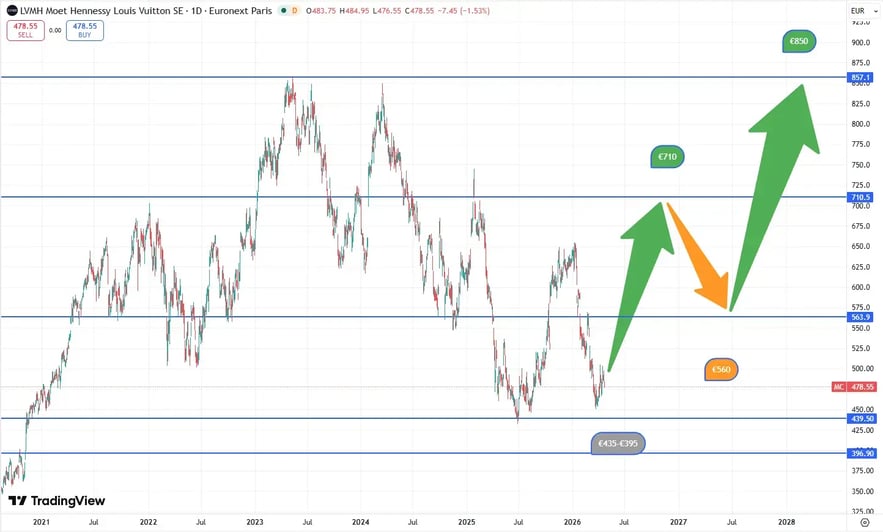
Most likely scenario: the green arrow
From the current level, our model has calculated that LVMH is making its way up. The stock price is near a strong historical support zone around €440, a level that has acted as a bottom several times before. We assume that the bottom will be formed or has already been formed here and that the recovery movement will start towards €560 as the first resistance level. After that, €710 is the next stop, with €850 as the ultimate long-term price target.
Alternative scenario: correction towards gray area
We want to be absolutely clear about this: there is a real chance that the price will first fall towards the €435 - €395 zone before the upward movement finally starts. This is not a catastrophic scenario, it is a possibility that every investor should seriously consider. The support around €395 forms the absolute bottom in this.
Waiting for that lower zone is understandable, but in practice this strategy fails more often than it succeeds. Those who wait for the perfect entry moment regularly stand by while the stock has already risen 20%. Our approach is therefore: consider building an initial position now around the current price and buy should the price fall to the €435 - €395 zone. That way you benefit in both scenarios and get an attractive entry price on average.
Conclusion
LVMH's share price currently tells a different story than its fundamentals warrant. Currency headwinds, geopolitical uncertainty and a temporarily weak European consumer have depressed sentiment. Meanwhile, the company just keeps performing: Watches and Jewelry is growing, Sephora is grabbing market share and Asian demand is picking up. Its portfolio of more than 75 brands is absorbing headwinds in a way that no other company in the luxury sector can match.
The stock price is at a level that has historically presented opportunities for investors with a one- to two-year horizon. Our advice is clear: start an initial position now and buy in the €435 - €395 zone if the market gives us that opportunity. Those who do so will position themselves for a recovery movement toward €710 and ultimately the long-term price target of €850.
On July 28, 2026, LVMH will present its half-year results. That will be the moment when it will become clear whether the recovery in Asia actually continues and sentiment may tilt. We are keeping a close eye on the situation and will come back with a new analysis by then
Disclaimer: Investing involves risks. Our analysts are not financial advisors. Always consult an advisor when making financial decisions. The information and tips provided on this website are based on our analysts' own insights and experiences. They are therefore for educational purposes only.
.webp)

.webp)
.webp)