.svg)
.svg)
.svg)
.svg)
.svg)
.svg)
.svg)
.svg)
.svg)
.svg)
.svg)
.svg)
Publication date: Jan. 8, 2026
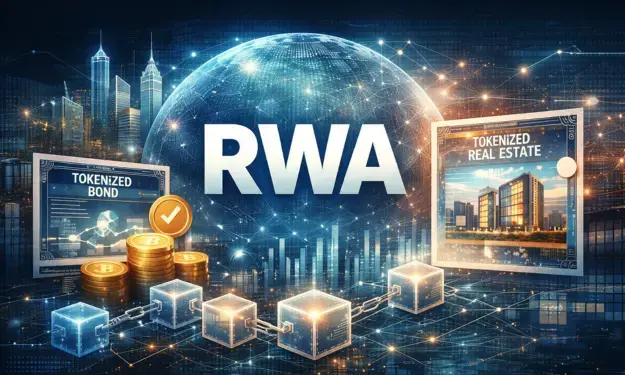
The crypto market is at the beginning of a new phase. Whereas in recent years the focus has been mainly on price movements and speculation, in 2026 the focus is shifting more and more emphatically to applications with a clear economic function. One of the most important developments in this is the tokenization of real-world assets, often abbreviated to RWA. Here, existing financial assets such as bonds, real estate and mutual funds are converted into digital tokens on the blockchain.
What are real-world assets within crypto?
Real-world assets are tangible or traditional financial possessions that have existed for decades. Think of government bonds, corporate bonds, real estate projects, equity funds, or commodities. In tokenization, the ownership or economic interest of such an asset is captured in digital tokens on a blockchain.
For example, a bond can be broken down into thousands of digital pieces, each representing a small portion of its value. These tokens are then easily tradable and immediately visible to all participants. In this regard, the blockchain acts as a transparent and automatic cash book.
Why is tokenization breaking through just now?
Interest in RWA has increased dramatically as major financial institutions are actively pursuing blockchain technology. Names like BlackRock, Franklin Templeton and major banks are experimenting with issuing and managing tokenized funds and bonds. This is a clear signal that blockchain is no longer seen as a niche technology.
In addition, regulations in Europe and the United States are providing more clarity. Legislation around digital assets makes it possible for institutional parties to work with blockchain in a regulated and controlled way. As a result, large investors and asset managers are daring to take steps that were unthinkable just a few years ago.
The key players within real-world assets
Within the development of real-world assets, two clear frontrunners are now visible. These projects each play a distinct role within the RWA ecosystem, demonstrating how blockchain and traditional financial markets come together.
- Chainlink: This project performs a crucial infrastructure function within tokenization. With real-world assets, it is essential that real-world data such as interest rates, prices and contract terms are captured correctly and reliably on the blockchain. Chainlink provides this data link between traditional financial systems and blockchain networks. This is precisely why the project is attractive to banks and institutional parties working with tokenized bonds, funds and other financial products.
- Ondo Finance: This project plays an important role on the application side. Ondo Finance focuses specifically on tokenizing traditional financial instruments such as U.S. government bonds. Through blockchain, investors gain access to returns normally available only through banks or asset managers. This makes Ondo Finance a concrete example of how real-world assets within crypto work in practice.
Together, these projects show that real-world assets are not about hype, but about infrastructure, reliability and real-world applications. This explains why precisely this segment will play a defining role in the further maturation of the crypto market in 2026.
Why 2026 will be a tipping year
Many projects around real-world assets are currently in the transition from test phase to actual application. By 2026, tokenized bonds, funds and real estate products are expected to become more widely available not only to institutional parties but also to retail investors.
In practice, investors buy these RWA products through platforms and providers that issue the tokens, while the blockchain operates largely in the background. This also applies to tokenized real estate, which is offered in digital tokens through specialized providers, allowing investors to participate economically without owning real estate directly.
For retail investors, this means that large investments can be broken down into smaller parts, with greater transparency and faster settlement. This creates room for more stable digital investments, such as bonds and real estate, in addition to volatile crypto tokens.
With this, crypto continues to grow from an alternative market to an addition to the existing investment landscape in 2026.
Conclusion
Tokenization of real-world assets marks an important shift within the crypto market. Whereas blockchain has long been associated primarily with speculation, RWA shows how the technology can be used for real-world financial applications. Making traditional assets such as bonds and real estate available digitally creates a more efficient, transparent and accessible financial system.
The increasing involvement of institutional parties, clear regulations and working applications make it clear that this development is more than a temporary trend. By 2026, tokenization will shift from experiment to practice and become a structural part of financial markets.
For investors, this means new opportunities, but also a different way of looking at crypto. No longer focusing only on price movements, but on underlying value and usage. Real-world assets thus form an important foundation for the next phase of crypto and underline why 2026 will be a decisive year.
Disclaimer: Investing involves risk. Our analysts are not financial advisors. Always consult an advisor when making financial decisions. The information and tips provided on this website are based on our analysts' own insights and experiences. They are therefore for educational purposes only.



-2.webp)