.svg)
.svg)
.svg)
.svg)
.svg)
.svg)
.svg)
.svg)
.svg)
.svg)
.svg)
.svg)
Tesla released its financial results for the second quarter of 2026 this week. The results show a clear split. The automaker is showing visible signs of recovery, with record deliveries and strong revenue growth. At the same time, the billions invested in Cybercab, Robotaxi, and Optimus are putting significant pressure on profitability. It’s time to take a closer look at the key figures and look ahead to what investors can expect in the coming period.
The last time we wrote about Tesla was on September 18, 2025. To stay fully informed, you can read that article here:
“Tesla: Stock Price Accelerates Like a Rocket. Get Ready for the Next Sprint!”

What are the key figures for the second quarter?
Last Wednesday, Tesla released its second-quarter 2026 financial results. Revenue rose 26% to $28.2 billion, well above the expected $27.6 billion. Revenue from vehicles grew by 23% to $20.5 billion, while Services and Other, which includes maintenance and repairs, increased by 50% to $4.6 billion. Tesla delivered 480,126 vehicles, 25% more than a year earlier and its best second quarter ever.
However, bottom-line profits were significantly lower than expected. Operating profit, the amount remaining from core operations before interest and taxes, fell by 57% to $398 million. As a result, the operating margin dropped from 4.1% to just 1.4%. The gross margin also came in lower than expected at 16.8%. Adjusted earnings per share were $0.33, compared with an expectation of approximately $0.50.
Free cash flow, the capital remaining after all costs and investments, turned negative at $1.1 billion. Investments rose to $5.8 billion, compared to $2.4 billion a year earlier. This money is primarily going toward AI computing power, battery production, and a proprietary chip factory, as well as the development of Cybercab, the Tesla Semi, and the Optimus robot. With $43.5 billion in cash, Tesla still has a substantial buffer to finance this costly phase.
There is also good news in the figures. The number of active subscriptions to Full Self-Driving, Tesla’s self-driving software, grew by 56% to 1.48 million. In North America, more than half of new Tesla buyers have now opted for this feature, which is valuable because software is typically much more profitable than car sales. In addition, production of the Cybercab began in Texas, and the self-driving taxi service expanded to multiple cities in Texas and Florida.
The market reacted sharply. The stock initially fell by about 3% in after-hours trading, but that decline widened to over 14% the following trading day, the largest drop in more than a year. Investors seem to be waiting above all for tangible evidence that the billions invested in AI and autonomous driving will eventually become profitable.
What is the analysts’ outlook on Tesla’s stock price?
Analysts are clearly divided on Tesla. The average rating is “Hold,” with an average 12-month price target of approximately $420 to $425. The range among analysts is unusually wide: price targets vary from approximately $125 to $600. Wedbush analyst Dan Ives is the most outspoken optimist with a price target of $600 and points to an accelerated rollout of Robotaxi in more than thirty U.S. cities. On the other end of the spectrum, skeptical analysts point to the high valuation relative to the core automotive manufacturing business.
This clear split reflects the core of the Tesla story: the existing car business is recovering, but the valuation is primarily based on the promise of AI, Robotaxi, and Optimus. That promise still needs to translate into concrete profits in the coming quarters.
What is Yelza’s outlook on Tesla’s stock price?
Below you’ll find Tesla’s stock price chart starting in mid-2024. The arrows show, at a glance, the most likely scenario according to our model.
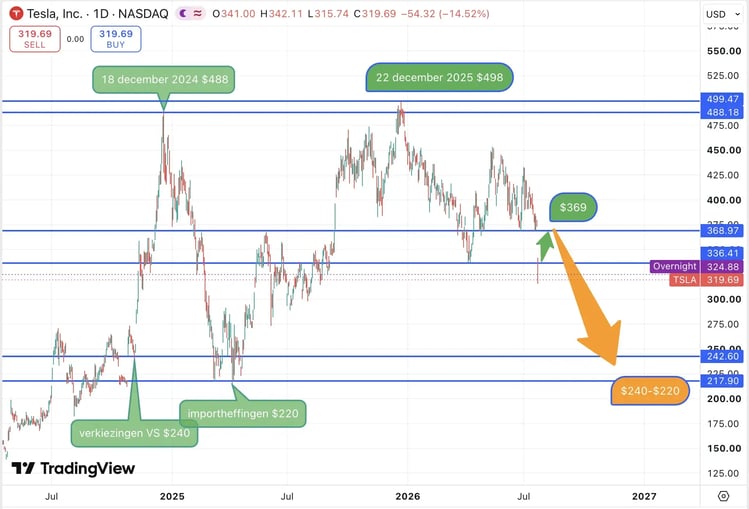
Tesla’s stock price has been highly volatile for the past two years. After peaking at $488 in December 2024, a sharp correction toward $220 followed, triggered by the announcement of import tariffs. From that level, the stock price began a strong recovery, culminating in a new peak of $498 in December 2025. Since then, Tesla has been in a downward trend again, with the stock price currently hovering around $320.
Our algorithm sees room for a short-term technical rally toward $369. This level has historically served as an important support and resistance zone and, according to our system, represents the most likely upper limit of the current recovery.
From that zone, we expect the underlying weakness to regain the upper hand. The model points to a substantial follow-up correction toward the $240 to $220 range by the end of 2026. This is the same range that has previously served as a bottom twice, which makes the level technically even more significant. For the period thereafter, the picture is decidedly less clear-cut. Our system deliberately does not provide a scenario for 2027, given the exceptional uncertainty surrounding Tesla’s long-term valuation as an AI and robotics company.
Conclusion
The technical picture and the quarterly results point in the same direction: for now, the recovery in core operations does not offset the pressure on profitability. We therefore anticipate a final rally toward $369, followed by a sharp correction toward the $220–$240 range by the end of 2026.
If you already hold a position in Tesla, you might consider using any rally toward $369 to tactically reduce your position. If you do not yet have a position, you might consider letting this rally pass and only considering an entry in the $220–$240 range, a level that has already served as a strong support twice in the past.
For the period after 2026, we are deliberately keeping our outlook open, given the significant uncertainty surrounding the stock’s long-term valuation.
Disclaimer: Investing involves risks. Our analysts are not financial advisors. Always consult an advisor when making financial decisions. The information and tips provided on this website are based on our analysts’ own insights and experiences. They are therefore intended for educational purposes only.
.webp)

.webp)
.webp)