.svg)
.svg)
.svg)
.svg)
.svg)
.svg)
.svg)
.svg)
.svg)
.svg)
.svg)
.svg)
Publication Date: July 24, 2026
Since May, the U.S. Federal Reserve has had a new chair who has personally invested in more than thirty crypto projects and once described Bitcoin as “the new gold for everyone under forty.” You’d expect the crypto market to be happy about that. Yet the Bitcoin price actually fell after his first major public appearances. That’s no coincidence, and it says something important about how interest rate policy and crypto are truly interconnected.
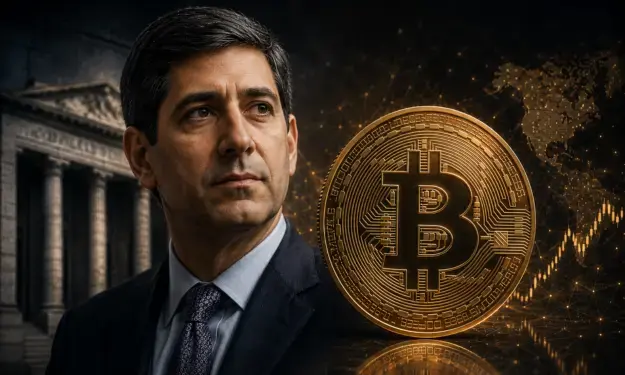
Who is Kevin Warsh?
Kevin Warsh is no stranger to the financial world. He previously served as a governor at the Federal Reserve from 2006 to 2011, right in the midst of the financial crisis. In May 2026, following a close Senate vote, he was sworn in as the new chairman. His personal investment portfolio includes holdings in Solana, the prediction platform Polymarket, and various smaller crypto projects, among others.
He has publicly compared Bitcoin to gold and has been outspokenly critical of a digital central bank currency. On paper, this makes him the most crypto-friendly Fed chair in the institution’s history.
Why interest rates are so important for crypto
To understand why this isn’t automatically good news for the price, it helps to understand what the Fed actually does. The Federal Reserve sets U.S. interest rates, and those rates have a ripple effect throughout the global economy. When interest rates are low, borrowing is cheap, and simply leaving money in a savings account yields little return.
Investors are then more inclined to take risks, for example by investing in stocks or crypto, in search of a better return. If interest rates are high, the opposite is true: savings and safe bonds become more attractive, and riskier investments like crypto lose ground relatively speaking. That is the core reason why every word from a Fed chair is closely watched by the crypto market.
What Warsh has shown so far
During his first interest rate meeting on June 17, Warsh kept interest rates unchanged at 3.50 to 3.75 percent. That was in line with expectations. It was the tone surrounding the decision that caused the most concern. In a statement of barely six words, he emphasized that the committee “will deliver price stability.” At the same time, the dot plot—the chart in which Fed officials share their interest rate projections—dropped the last planned rate cut for this year. Nine of the eighteen committee members now even anticipate a rate hike before the end of 2026. Shortly thereafter, Bitcoin fell back toward $64,000, and more than $100 million flowed out of Bitcoin ETFs such as BlackRock’s IBIT at that time.
In mid-July, Warsh took the next step. During a hearing, he announced a task force to examine how the Fed communicates. The goal: to anticipate future policy less and focus more on current data. That sounds technical, but it certainly has consequences. Investors were accustomed to a Fed that shared its plans well in advance. From now on, they will have to factor in greater unpredictability surrounding each new meeting.
Bitcoin reacts to money flows, not to goodwill
Ultimately, it matters less to the Bitcoin price whether a Fed chair is positive toward crypto. The market focuses primarily on the direction of monetary policy. If interest rates remain high, money becomes scarce, and investors take on less risk, Bitcoin typically comes under pressure. If interest rates fall and more liquidity becomes available, there is actually more room for risky investments such as crypto.
That makes high U.S. inflation far more important than Kevin Warsh’s personal opinion. As long as inflation, at 4.2 percent, remains well above the 2 percent target, the Fed has little room to lower interest rates quickly. Even a chair who is positive about Bitcoin cannot simply deviate from that policy.
His reputation may spark optimism in the short term, but without an actual easing of policy, the impact on the price is likely to remain limited.
Conclusion
Interest rate cuts have now been postponed again, and that directly affects crypto. Bitcoin and other cryptocurrencies typically benefit from an accommodative monetary policy, in which money is cheaper and more widely available. In practice, a cautious Fed therefore acts more as a headwind than as a support, regardless of the chairman’s personal views.
For crypto, it ultimately comes down to one central question: Will money become cheaper and more widely available in the near future, or will monetary policy remain tight? As long as inflation remains high and interest rate cuts are postponed, this environment will remain challenging for crypto.
Investors would therefore be better off focusing on the policy itself rather than the person implementing it. Only when concrete interest rate cuts follow and financial conditions actually become more accommodative can that make a positive difference for the Bitcoin price.
Disclaimer: Investing involves risk. Our analysts are not financial advisors. Always consult an advisor when making financial decisions. The information and tips on this website are based on our analysts' own insights and experiences. They are therefore for educational purposes only.